When he was 5, Gregory Schaaf found five arrowheads and a stone tomahawk in his grandfather’s Missouri cornfield. “I knew nothing about Native Americans before my grandpa began telling me old family stories. At 8, I announced that I didn’t want any more toys. All I wanted was Indian arts and crafts. That year, Santa brought me a Navajo squash blossom necklace with real turquoise.”
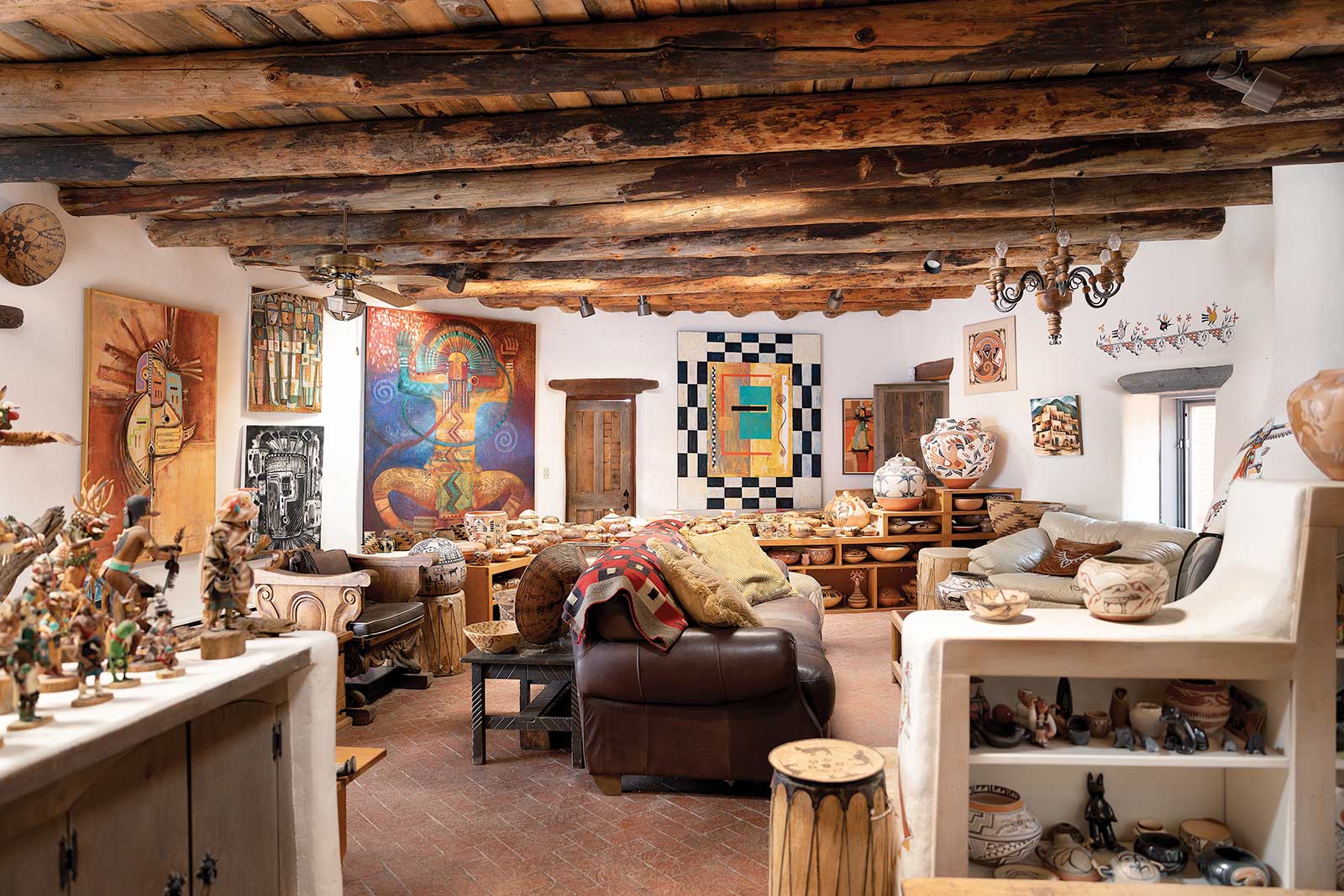 In the living room are (left to right) a Hopi Katsina collection, a painting by Dan Namingha (Hopi-Tewa); three paintings by Tony Abeyta (Navajo), including his large oil on canvas, Creation, exhibited in 1992 at the Wheelwright Museum, Santa Fe; and two additional paintings by Namingha. In the lower right, a Taos Pueblo drum, next to a selection of Pueblo Indian pottery.
“My grandfather and parents were wonderful storytellers. Every night my mother read to me from The American Heritage Book of Indians and other classic books. Then, my father told me true life stories, mostly about the people his family had helped to survive the Great Depression. We believe in a philosophy shared by many Native American Elders: ‘When you give and give and give, all the blessings of life will come back to you.’”
Gregory earned a doctorate in American history, with special emphasis in Native American studies, at the University of California, Santa Barbara. During his distinguished career he has taught at four colleges in California and Minnesota.
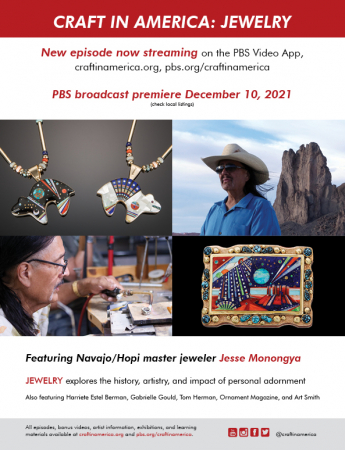
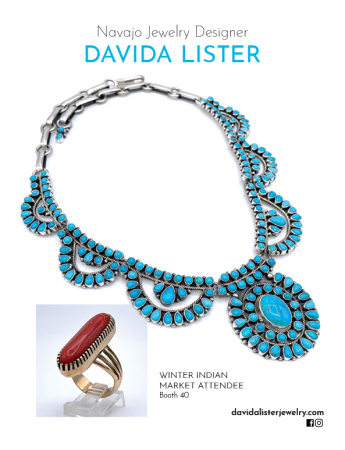
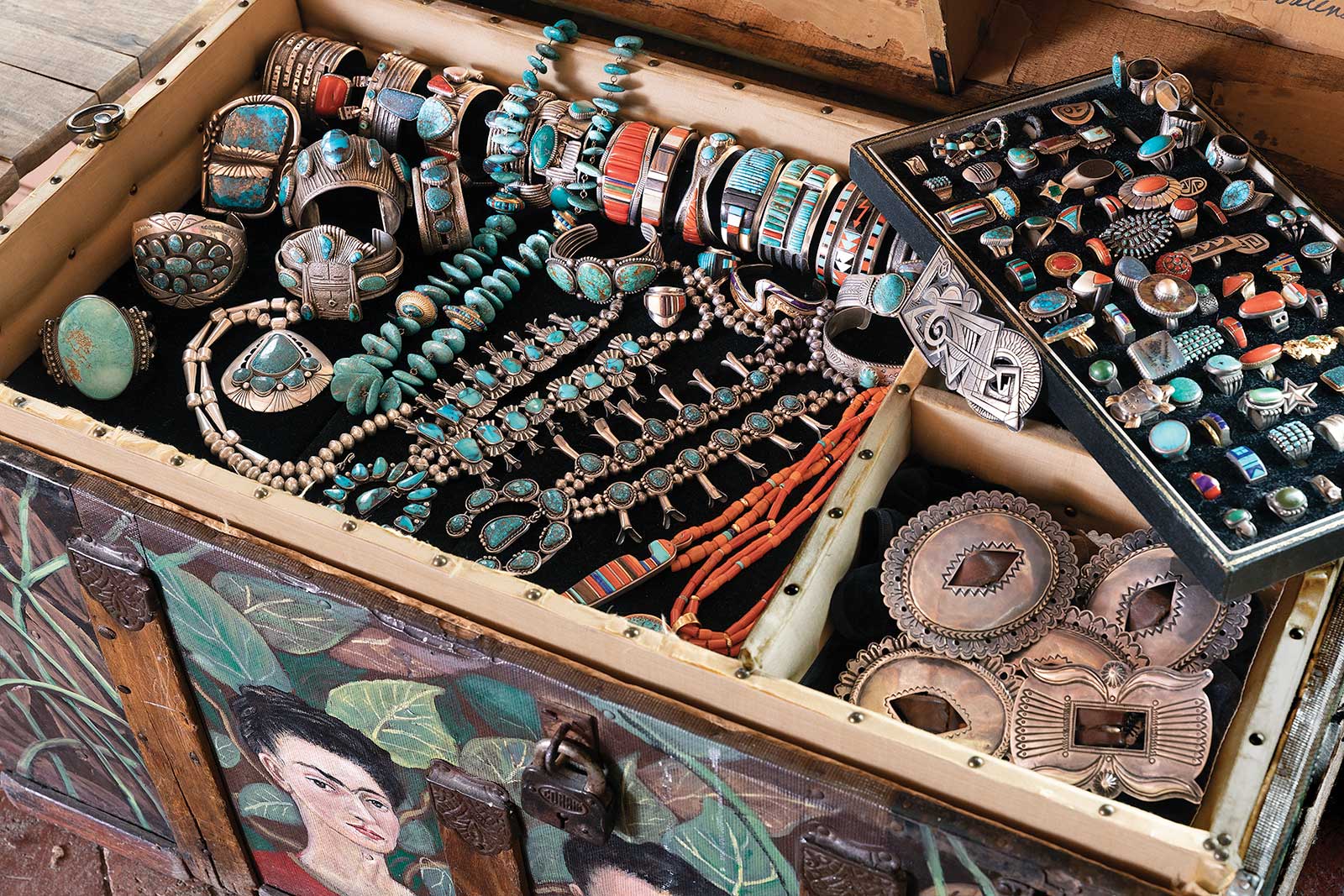 Gregory & Angie’s favorites: Charles Loloma (Hopi), Preston Monongye (Hopi), Jesse Monongya (Hopi/Diné/Navajo), Lee and Raymond Yazzie (Diné/Navajo), Michael Kaboti (Hopi), Verma Nequatewa (Hopi), Denise Wallace (Chugach Aleut), Perry Shorty (Diné/Navajo) and Tony Abeyta (Diné/Navajo). On the lower right is a First Phase Navajo Concho Belt, ca. 1880, with an interesting provenance: Chief Chee Dodge (first Navajo Tribal Chairman), Annie Wauneka (his daughter), Tom Woodward (trader), sold at Butterfields Auctions, San Francisco, ca. 1970s, purchased by Lauris and Jim Phillips, sold to private Albuquerque collector, then to the Schaafs.
In 1982, when Gregory was working as a historian for the Traditional Hopi, he helped the Elders compose three statements for the United Nations on “Hopi Prophecies,” “Religious Freedom,” “Nuclear Disarmament.” In 1987, he was personally invited to speak before the United Nations on “Native American Peace Making Traditions.”
In 1987, he testified as an expert witness before the U.S. Senate Select Committee on Indian Affairs, representing the Iroquois Confederacy with Oren Lyons, Faithkeeper of the Onondaga Nation. Their bill passed 100 to 0, officially recognizing “Iroquois Influences on the U.S. Constitution.”
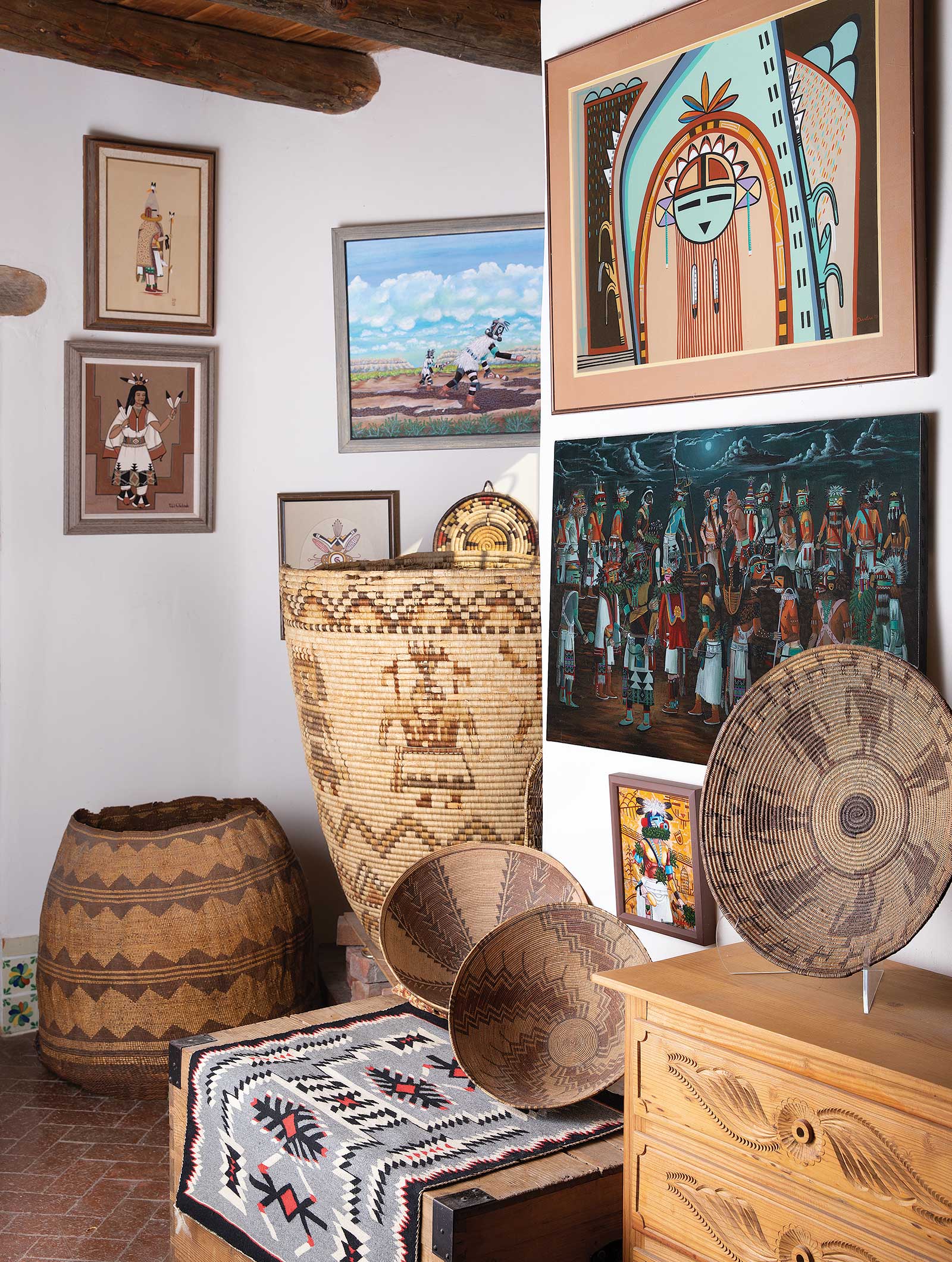 Native American baskets include a Hupa storage basket, ca. 19th century; a Hopi Katsina basket by Nellie Quamalla, completed in 1923; a Kawaiisu coiled bowl, ca. 19th century; a Kawaiisu coiled bowl, ca. 19th century; a Western Apache figural basket, ca. 1890. On the wall are paintings by White Bear Fredericks (Hopi), Pablita Velarde (Santa Clara), Coochsiwukioma Delbridge Honanie (Hopi), Milland Lomakema (Hopi), Raymond Naha, Jr. (Hopi) and Anthony Honahnie (Hopi).
Gregory continued teaching, while working as a historian for over 50 Native American Nations. He helped build tribal museums, libraries and archives. He recalls the time when Chief Swamp held up a special Mohawk basket, woven by his Aunt Mary Adams, as a symbol of the “Tree of Peace.” Her fine baskets inspired Gregory to build a basket collection.
“I was about 30 years old when I bought by first basket, and I went out to buy all the books I could get my hands on,” he comments. “They were about collectors of California baskets, which are my favorite. I always have my magnifying glass and closely study the illustrations in books and catalogs. I saw one basket and knew that someday I’d like to find one like it. It took 30 years of looking and looking and looking, but I found one.
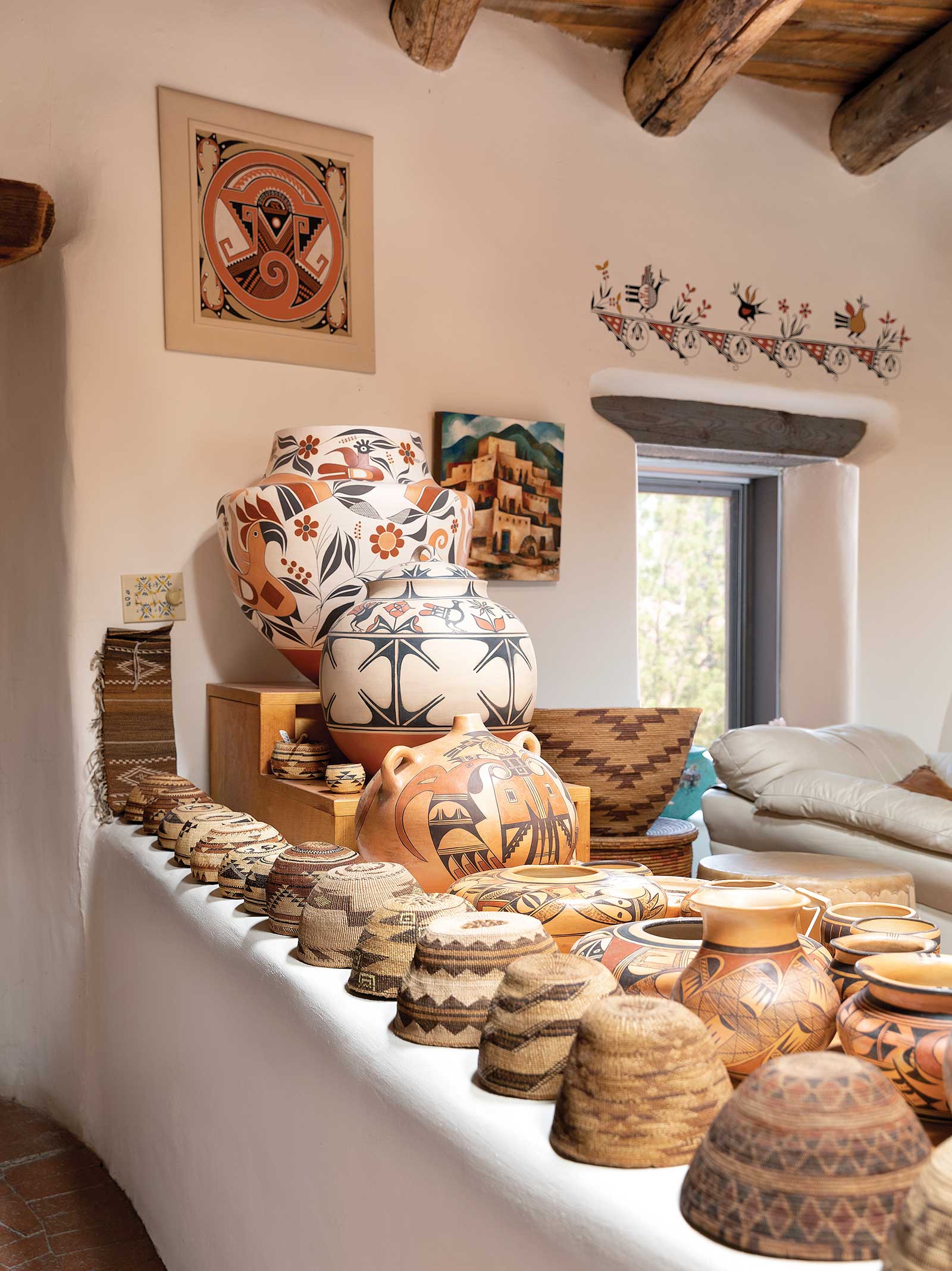 Fourteen California Indian women’s basketry hats, ca. 19th and 20th centuries, are on a counter in the living room.The Pueblo pottery is (top to bottom) a large olla by Joseph and Barbara Cerno (Acoma); a large storage jar by Robert Tenorio (Kewa); a large canteen by Nyla Sahmie (Hopi-Tewa); works by Nampeyo and family (Hopi-Tewa) and a Maidu Cooking Basket, ca. 19th century. The paintings on the wall are (left to right) Pablita Velarde (Santa Clara), Tony Abeyta (Diné/Navajo) and Elizabeth Medina (Jemez/Zia), painted directly on the wall.
“When I was teaching Native American Studies in Northern California, my basket collection grew rapidly. Once my Native students learned of my special interest, they began introducing me to their grandmothers who were honored basket weavers.
I recorded many hours of oral history tapes, the basis of my first educational documentary, A Treasury of California Indian Baskets.” More than 30 years later, the basket collection grew to more than 300 baskets, documented in a large reference book: American Indian Baskets: 1,500 Artist Biographies.
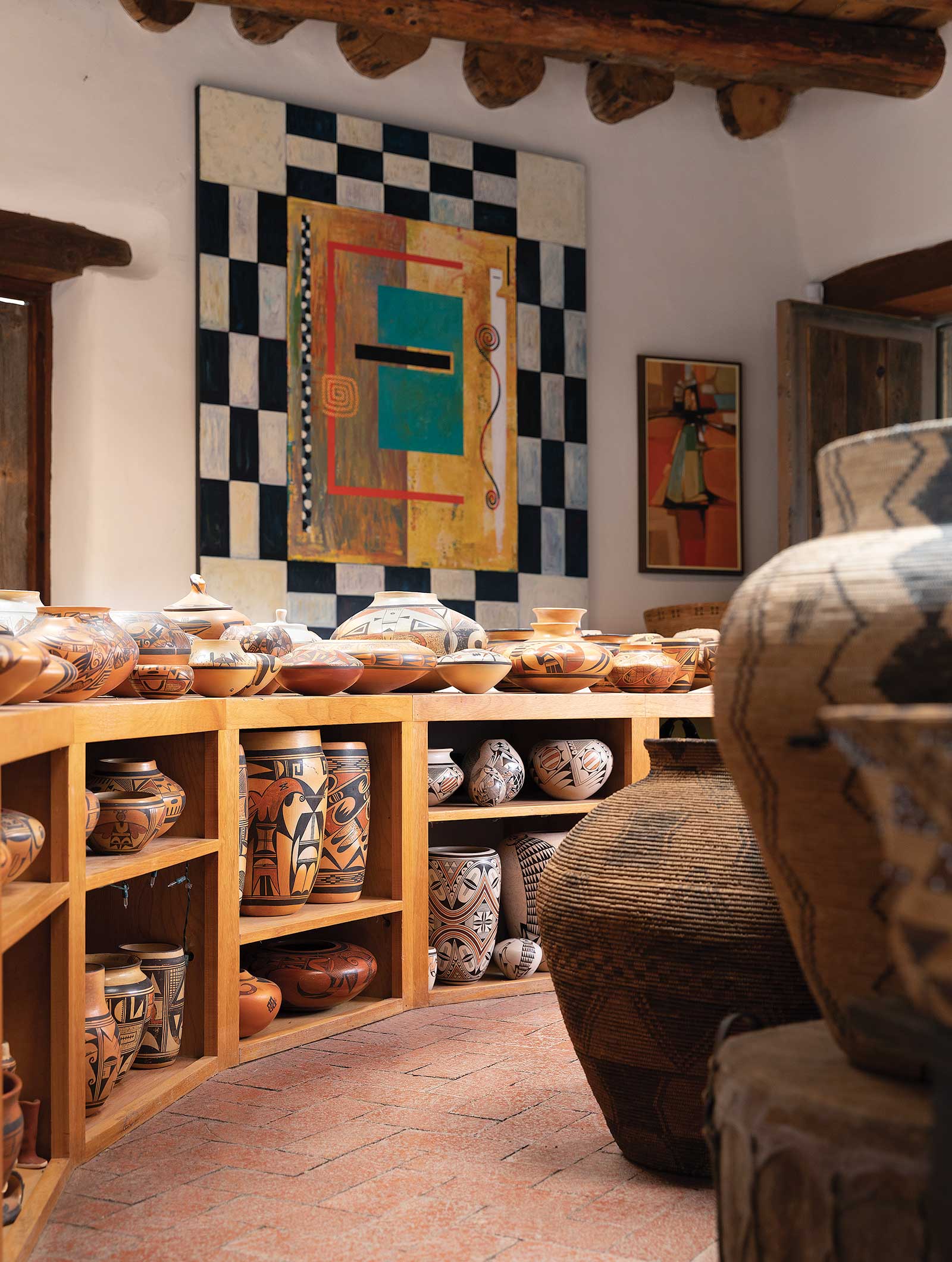 Hopi-Tewa pottery, Western Apache olla baskets and a Taos drum are displayed in the living room. The paintings are by Dan Namingha (Hopi). The large painting was featured on the cover of the book, The Art of Dan Namingha by Thomas Hoving.
In 1995, Gregory retired early and moved to Santa Fe, New Mexico, an important center for Native American artists. He decided to work full time on his plan to write an encyclopedia on Native American art and artists. “My old friend, Chiricahua Apache sculptor and painter Allan Houser (1914-1994), gave me the final push I needed. He challenged me, ‘Climb down out of that ivory tower, roll up your sleeves and go to work on your dream.’”
After working for three years on the “American Indian Art Series,” Gregory neared the completion of the first volume—Hopi-Tewa Pottery: 500 Artist Biographies. He then began searching for a professional book designer.
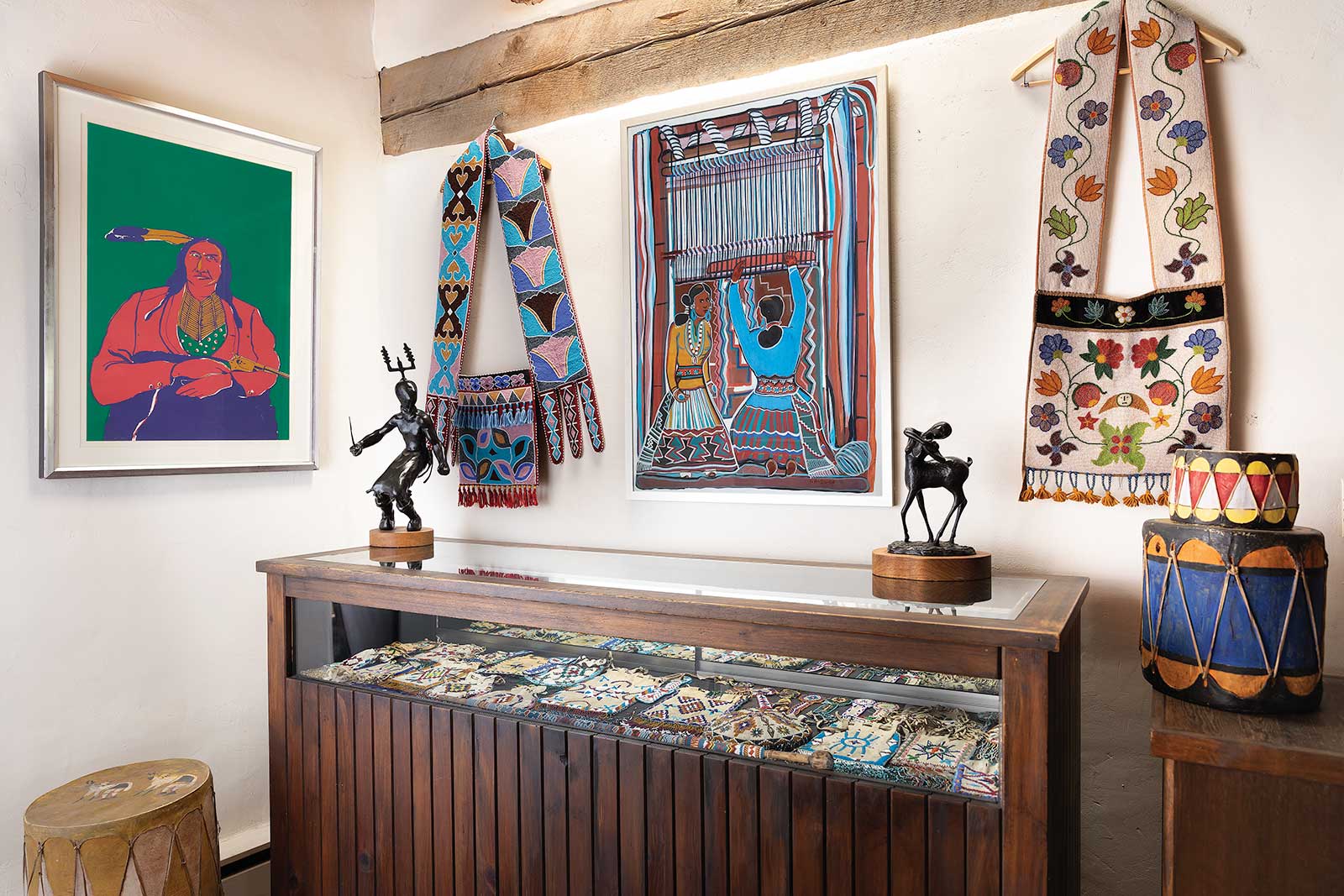 The display case is full of beaded bags by the Chiricahua Apache, including a bag by Geronimo’s daughter, Eva Geronimo, dated 1909. The two bronze sculptures by Michael Naranjo (Santa Clara). There are two antique Pueblo drums on the adjacent table. On the walls are (left to right) an original lithograph by Fritz Scholder (Luiseno/German, 1937-2005); a Lenni Lenape (Delaware) beaded bandolier bag; a painting by Ha-So-De (Narciso Abeyta) (Diné/Navajo), and an Anishinaab/Chippewa beaded bandolier bag.
Fortunately, he met and hired Angie Yan, an experienced designer, photographer and fine artist. After months of working side-by-side, she sent him on a special mission, “Go out and find the greatest printer in America.” Finally, he connected with David Gardner, the award-winning printer for American photographer Ansel Adams, as well as the J. Paul Getty Museum and the Los Angeles Museum of Art. “When the first book was printed, with a special edition bound in real buffalo hide, it was like our baby,” he comments.
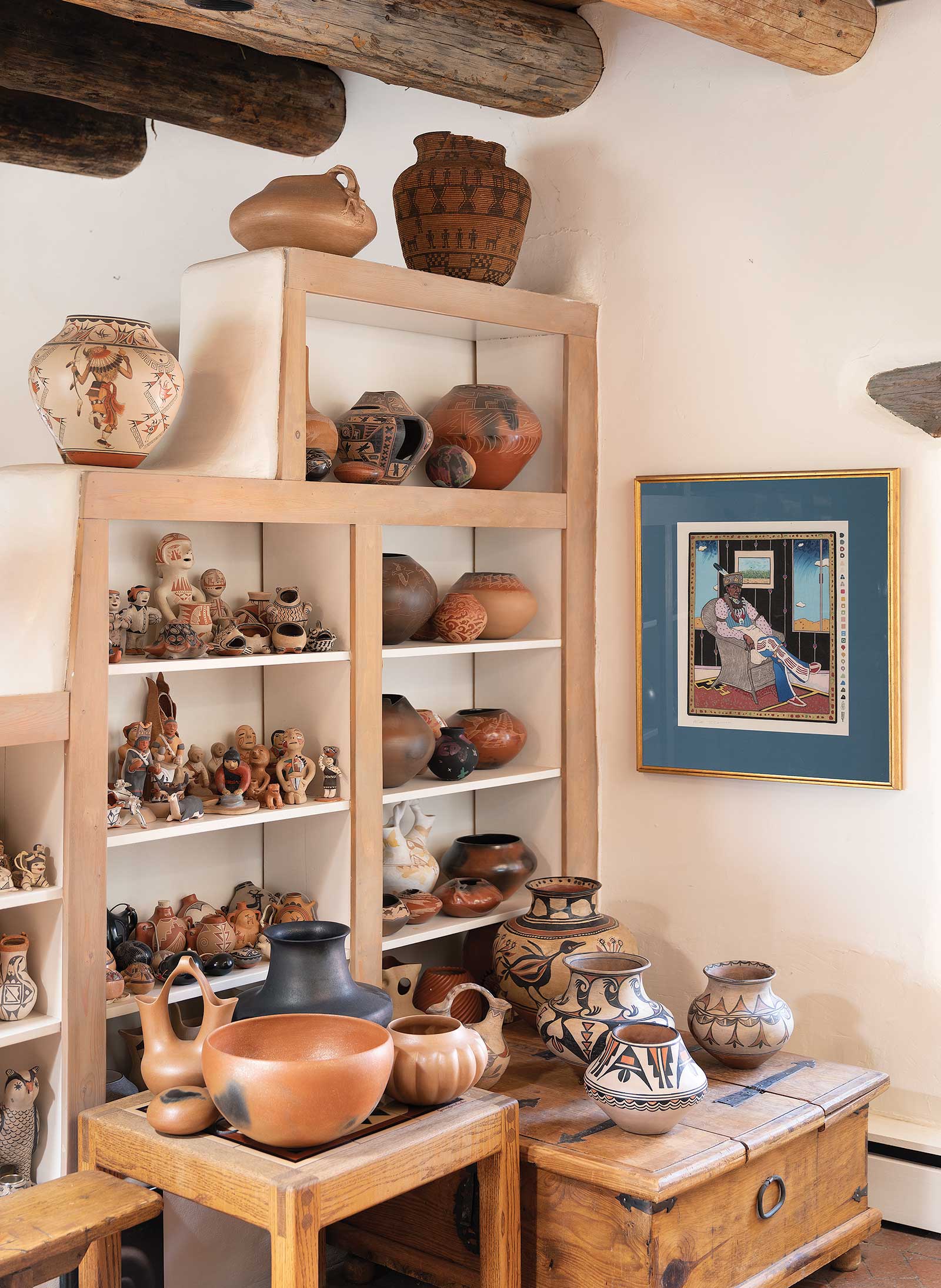 Osage with Van Gogh (Collector #5), an original woodcut by T.C. Cannon (Kiowa/Caddo, 1946-1978), overlooks a selection of pottery by Maria Martinez (San Ildefonso, 1887-1980), Robert Tenorio (Kewa), Lonnie Vigil (Nambé), Christine McHorse (Diné/Navajo, 1948-2021), Marcellus and Elizabeth Medina (Zia), the Folwell family (Santa Clara) and others.
Fifteen years later, Greg and Angie completed the ninth volume in the series, profiling a total of 17,000 Native American artists. Their art collection is available free of charge for loan to museums and educational centers. He and his wife live among thousands of Native American objects featuring historic and contemporary pottery, jewelry, textiles, carvings, beadwork, dolls, musical instruments, paintings and sculptures. Each object has a story and is cherished for its intrinsic value and for the connection to the artists. The purpose of their collections is educational, to promote Native American art around the world. To date, over 3 million people have seen selections of the “Dr. Gregory and Angie Schaaf Collection,” loaned to more than 25 museums, including the Smithsonian National Museum of the American Indian, the American Museum of Natural History, Heard Museum and the Indian Pueblo Cultural Center.
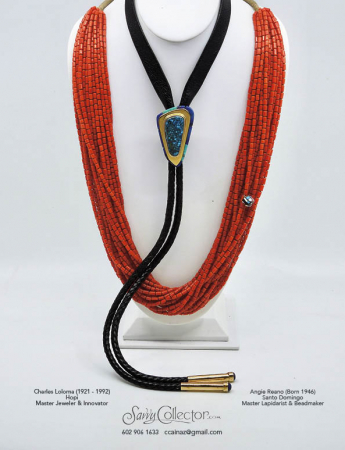
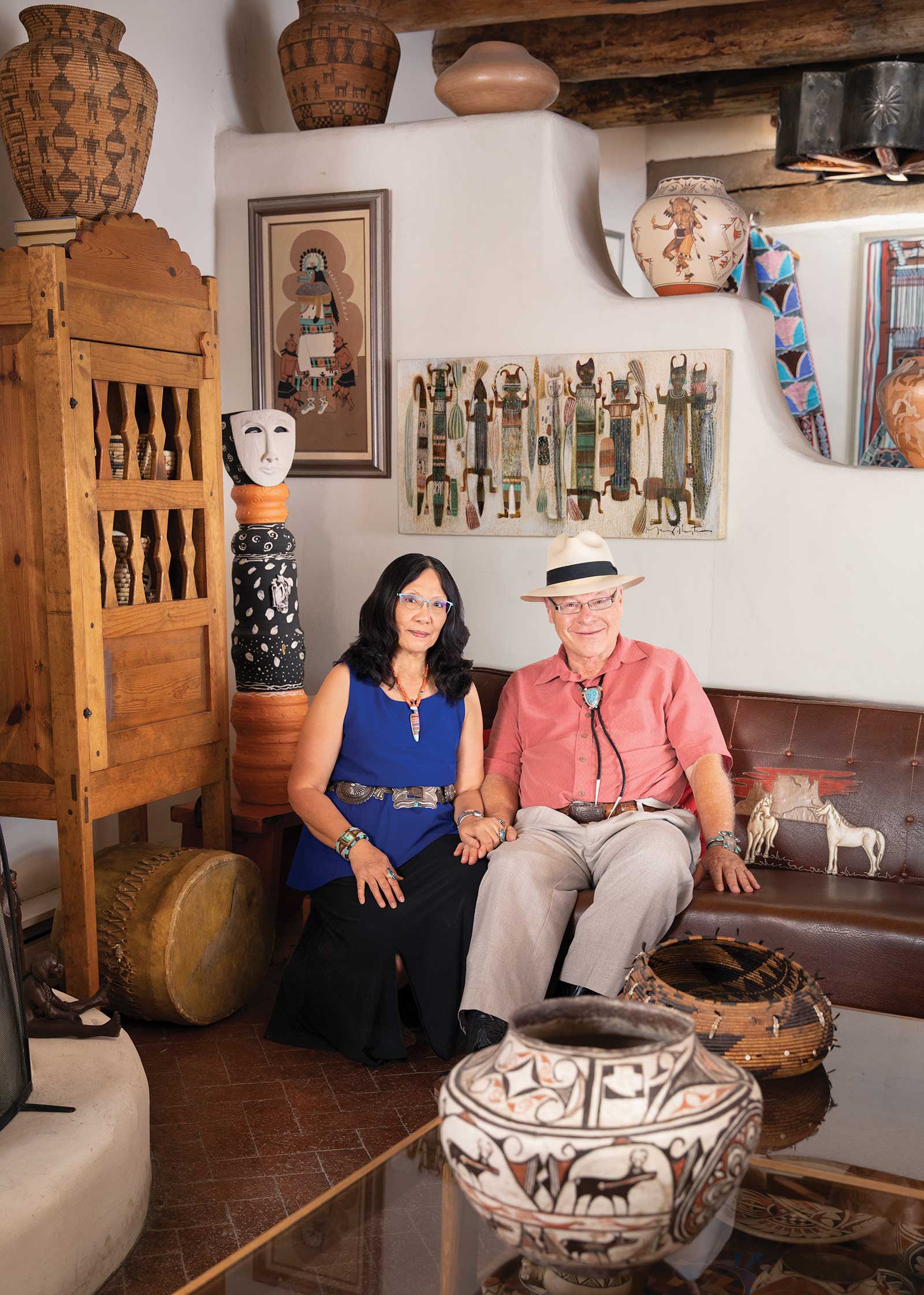 Angie is wearing a coral necklace with a Corn Maiden pendant by Charles Loloma (Hopi, 1947-1965), Early Third Phase concha belt (Diné/Navajo) and a beaded bracelet by Todd Bordeaux (Lakota/Rosebud Sioux). Greg is wearing a bolo by Verma Nequatewa (Hopi) with 100 carats of rare Nevada Blue turquoise. Near them are a Zuni polychrome pottery olla, ca. 1880; a deer with heartline design; a large Pomo boat basket with abalone shell pendants, ca. 1890-1910; a Taos Horse drum, ca. 19th century and a contemporary clay sculpture by Anita Fields (Osage/Muscogee). On the wall are (left to right): Zuni Shalako by Pablita Velarde (Santa Clara, 1918-2006) and Spiritual Deities Emerging from the Primal Ooze by Tony Abeyta (Diné/Navajo). On the top ledge is Traditional Dancers, a polychrome Zia olla, formed by Elizabeth Medina and painted by Marcellus Medina.
Among the contemporary artists in their collection is Diné/Navajo artist Tony Abeyta, whom they have known for 20 years. They began buying his work when he was living at Taos Pueblo and raising his family. Since then they have acquired 30 paintings and 35 pieces of his jewelry. “I’ve studied great artists and I knew a great artist when I saw one,” Greg says. “Tony will stand the test of time and will go down in history as a great artist.”
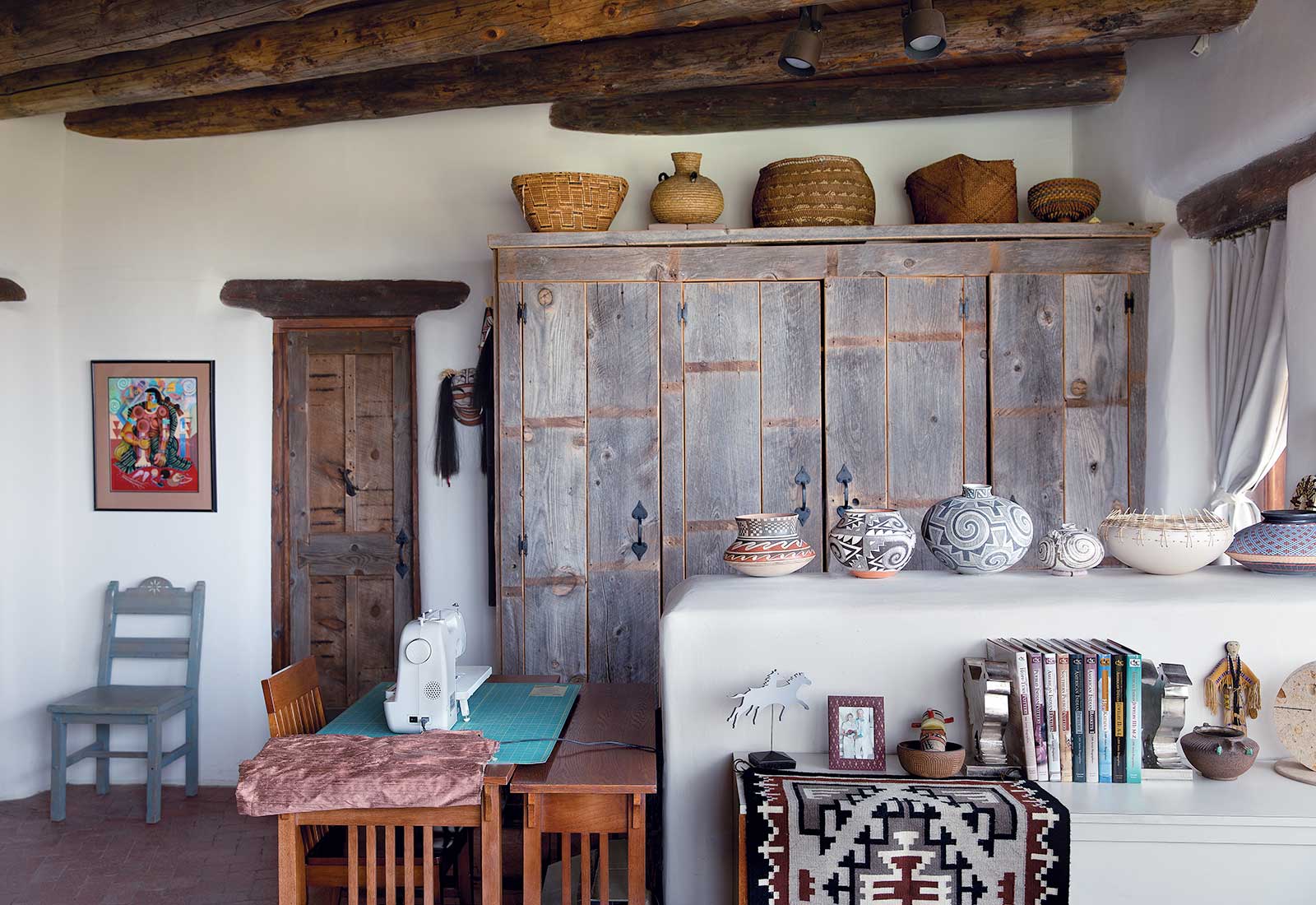 On the left is a painting by Michael Kabotie (Hopi). The baskets on top of the cabinet are (left to right): a 19th century Interior Salish imbricated basket; a Jicarilla Apache coiled water jar, ca. 1910; a Siletz twined feast basket, ca. 1920; Tsimshian plaited cedar storage basket, ca. 20th century; and a Penobscot fancy capote, ca. 1920. In the middle are (left to right): Casa Grande, Acoma and Tularosa pots, a contemporary white clay bowl with wicker rim by Jacquie Stevens and a second Casas Grande jar. On the front counter are (left to right): Horse & Rider, a steel sculpture by Bob Haozous (Warm Springs Apache), a stoneware bowl and jar by Otellie and Charles Loloma (Hopi, 1921-1993, 1947-1965), a Plains deerskin doll and a Two Grey Hills Diné (Navajo) Rug. In the left bowl is a katsina by Wilson Tewaquaptewa (Hopi).
In 2018, at the request of 68 Native American elders, Gregory and Angie created the non-profit Free Indian Market, determined to “Honor the Elders & Respect the Artists.” An all-volunteer team produced the show, and a successful benefit auction paid all the costs. In the second year, the show grew to 305, and in 2021 hosted 540 artists. “The successful artists returned home with over $2 million in their pockets,” he adds.
Gregory comments, “What is in our future? Imagine flying through the Indian art world in 3D virtual reality.”
Powered by Froala Editor